Moorish idols
moorish_idols_g381
Zanclus cornutus
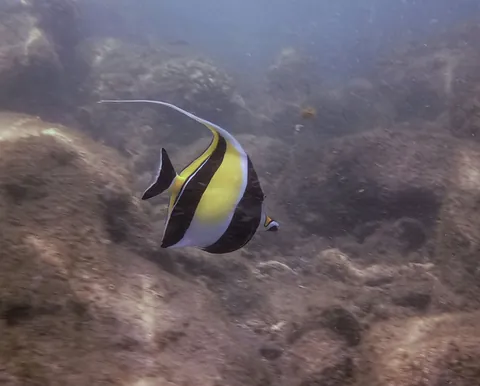
The Moorish idol is one of the most recognisable reef fish in the world: a thin, disc-shaped fish in black, white and yellow, trailing a long white streamer from its back. It reaches about 23 cm, with 21 cm more usual, and lives from around 3 m down to 182 m. It is the only living species in its family.
Also known as: zanclus cornutus, moonish idol
Look for the two wide black bars on a white body and the long white streamer trailing back from the dorsal fin, which no other reef fish of this shape carries. The snout is a yellow-saddled tube, and there is a yellow patch near the tail. The pattern is fixed and stays clear even in poor visibility, so you can name this fish from well across the reef.
The body is very flat from side to side and almost round, like a disc set on edge. The snout is drawn out into a tube with a small mouth full of long, bristle-like teeth. Adults grow small bony bumps above the eyes, like little horns. The fish is white with two broad black bands running down the body, a yellow patch towards the tail and a yellow saddle across the snout. The tail is black with a white rim. The front of the dorsal fin, the fin along the back, extends into a long trailing filament.
Moorish idols live across the tropical Indian and Pacific Oceans, from East Africa out to the central Pacific, and along the eastern Pacific coast of the Americas. They are not fussy: you find them on clear rocky and coral reefs facing the open sea, on shallow reef flats, and in murky inner lagoons. They also settle readily on artificial reef structures and on reefs that are being restored.
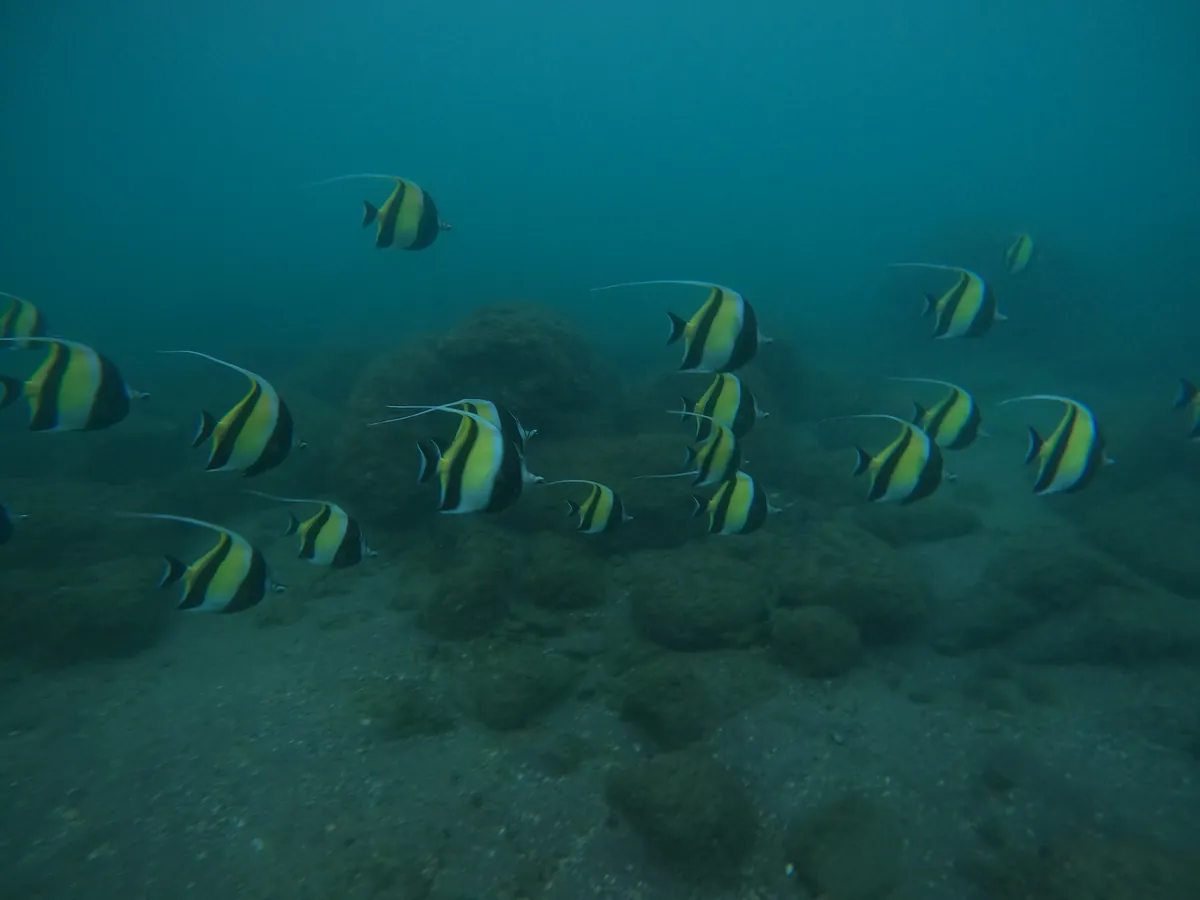
Most sightings are of one fish, a pair, or a small group of two or three, but they sometimes gather in large schools. They feed mainly on sponges, picking at small encrusting animals growing on the reef, and also take algae, coral polyps and sea squirts. The tube snout and bristle teeth let the fish reach into narrow cracks for this food.
Moorish idols spawn in open water. Males and females release sperm and eggs above the reef and the fertilised eggs drift away on the current. The young then spend a long time as larvae out in open water before settling on a reef. That long drifting stage is why the species is spread so widely and looks so similar everywhere.
harmless
It is listed as Least Concern. The species is widespread and common in many places, and no major threat to the fish itself is known. The coral reefs it lives on are in decline because of climate change, but this fish does well on restored reefs and artificial structures.
It is the last of its line. The Moorish idol is the only living species in its whole family, with no surviving close relatives anywhere in the sea.
Describe what you saw and we name it, then keep every species you find in your Oceandex.