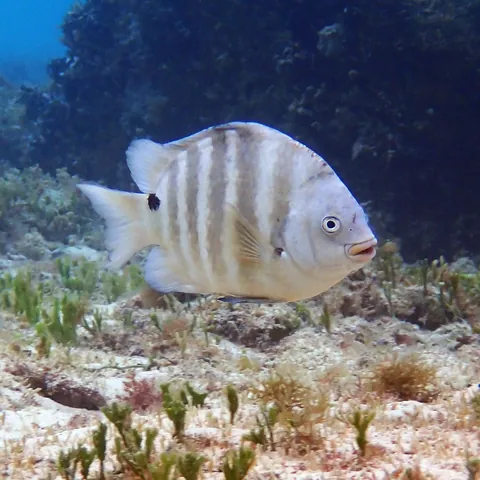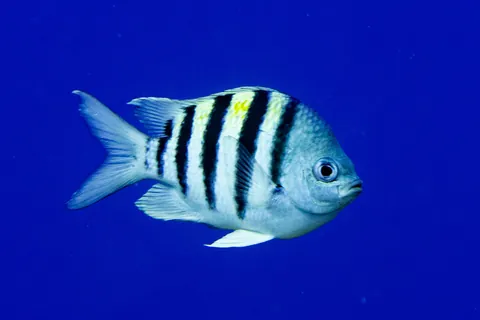
Atlantic Sergeant Major
Abudefduf saxatilis
Chromis chromis
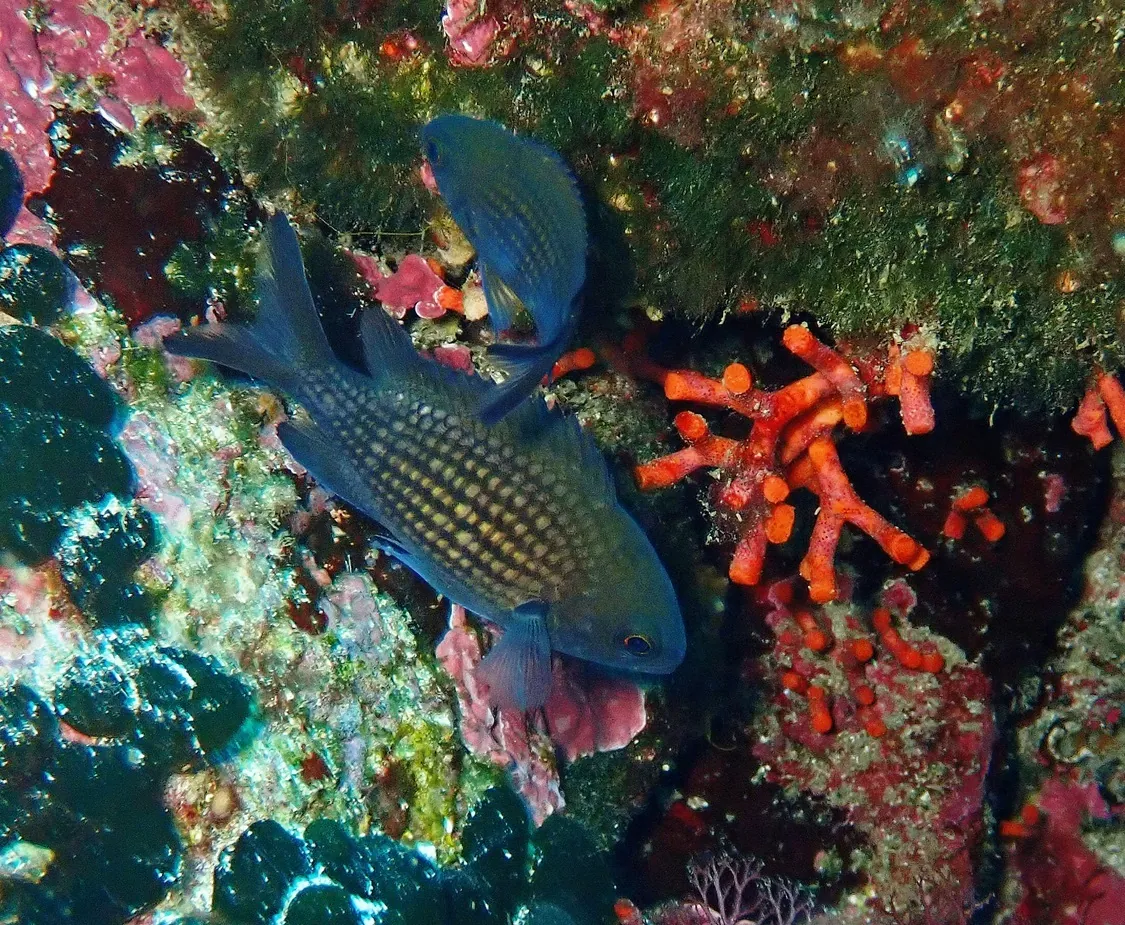
The Mediterranean chromis is a small, common damselfish often seen hovering in loose groups over rocky reefs. It reaches up to 25 cm, though most individuals stay closer to 13 cm.
Also known as: mediterranean chromis, damsel fish, mediterranean chromis, mediterranean damselfish, brown chromis
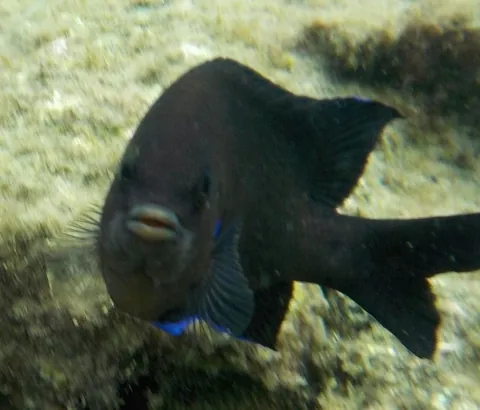
Adult colouring is a plain dark brown, easy to mistake for other small reef damselfish nearby. Look closely at the scales: each has a paler golden-brown centre, giving the body a faint dotted pattern that other local damselfish lack.
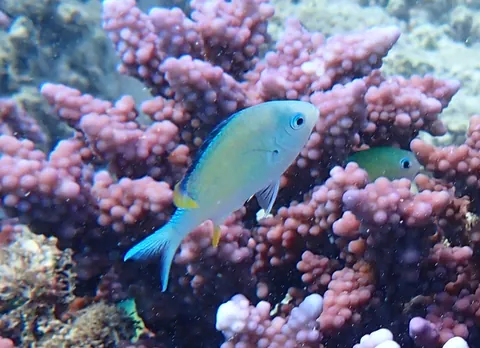
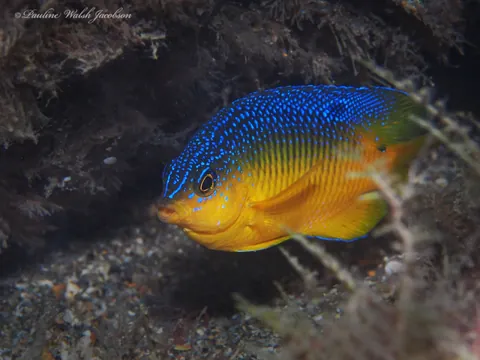
Its body is oval and flattened from side to side, with a noticeably large eye and a mouth that pushes forward to feed. Colour changes dramatically with age: the youngest fish are a brilliant iridescent blue, older juveniles show blue stripes with blue-edged fins, and adults turn dark brown with a paler golden-brown centre to each scale. Breeding males turn a vivid pale violet.
It lives along rocky coasts of the Mediterranean and Black Seas and the eastern Atlantic, from Portugal down to Angola. It forms small shoals in midwater near rocky reefs or over seagrass meadows, usually between 2 and 40 metres deep.
It feeds mainly on tiny drifting animals such as copepods and other zooplankton, along with fish eggs and larvae, and some algae growing on the seabed. When there is heavy activity near the surface, the group dives to deeper water and stops feeding to avoid it.
Spawning happens in summer, with timing depending on location. Pairs court before the female lays her eggs in a nest on a rocky or sometimes sandy bottom, where they stick to the substrate. The male stays behind to guard the eggs.
When there is a lot of activity near the surface, a whole shoal will dive together to deeper water and abandon feeding until the disturbance passes.
Describe what you saw and we name it, then keep every species you find in your Oceandex.