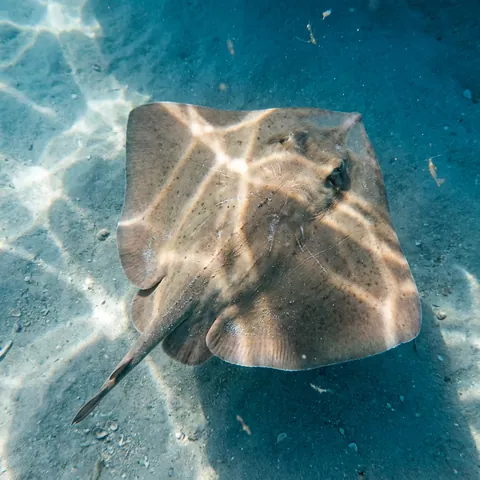
Lessa's Butterfly Ray
Gymnura lessae
Gymnura poecilura
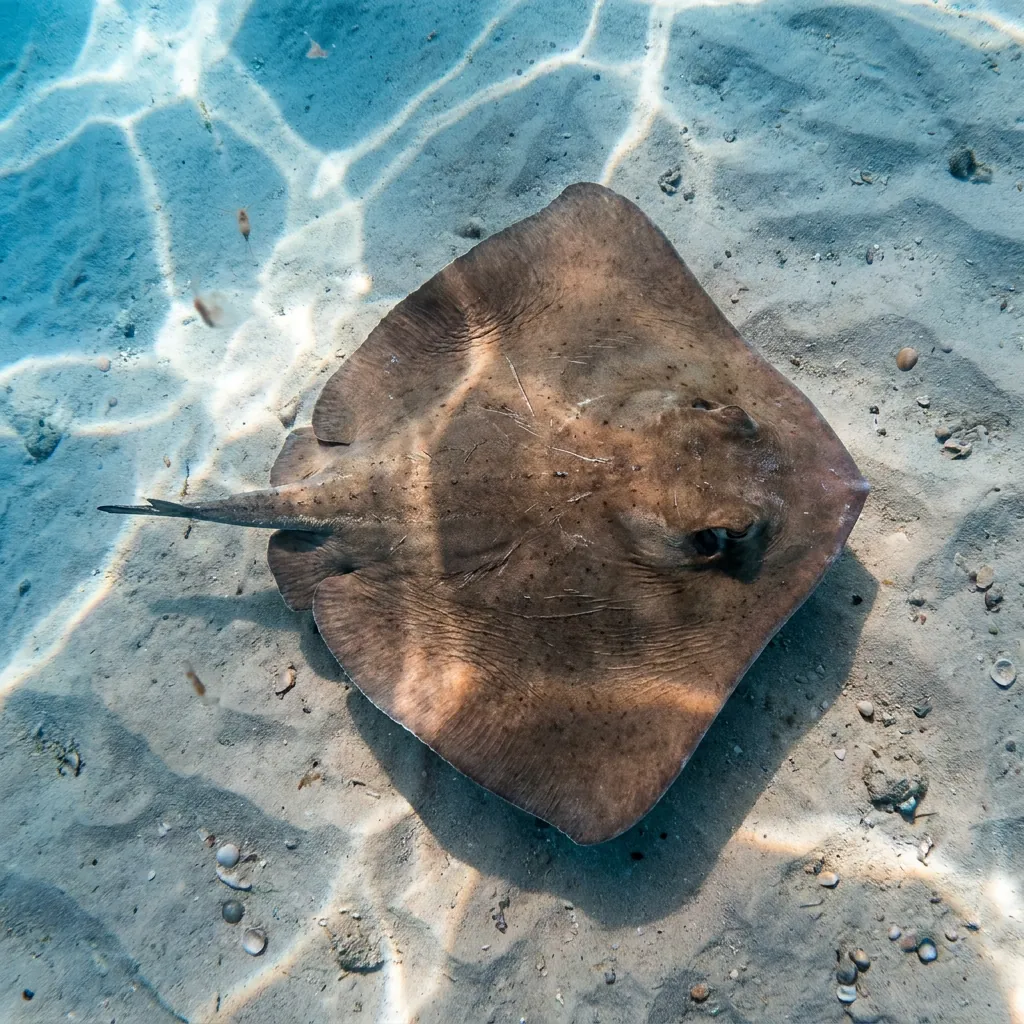
The longtail butterfly ray is a flat, diamond-shaped ray with a long, whip-like tail, found across the coastal waters of the Indo-Pacific. It is the most widespread member of its family in the region.
Other butterfly rays in these waters have noticeably shorter tails. This species' tail is roughly as long as the distance from its snout to its vent, making it look distinctly longer-tailed by comparison.
Its pectoral fin disc is lozenge-shaped, roughly twice as wide as it is long, with a gently curved front edge and rounded outer corners. The snout is short and broad with a small pointed tip. It is brown to greenish-brown or gray above, scattered with many small pale spots, and white underneath, darkening toward the fin edges. The thin, thread-like tail has no fins, only low ridges running along its top and bottom, and is marked with alternating black and white bands, each pale band often holding a small dark spot. A small stinging spine sits near the base of the tail.
It lives on sandy or muddy seabeds in shallow coastal waters and on offshore banks, from the Red Sea and East Africa across India and Sri Lanka to China, southern Japan, the Philippines, and the islands of Indonesia. It stays on the bottom and does not appear to migrate with the seasons.
This ray hunts bony fish such as ponyfish, along with molluscs and crustaceans, and is usually found alone rather than in groups. It is viviparous: pups are nourished first by yolk, then by a nutrient-rich fluid from the mother, with litters of at least seven born after breeding that peaks between April and October.
Pups born in the same litter can differ from each other in color.
Describe what you saw and we name it, then keep every species you find in your Oceandex.