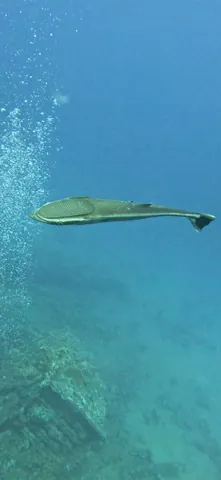
Common Remora
Remora remora
Echeneis naucrates
The live sharksucker is a hitchhiker of the open sea. Instead of swimming everywhere itself, it rides sharks, turtles, rays and even divers, catching a free lift and a share of the leftovers.
Also known as: live sharksucker, sharksucker, shark sucker, slender suckerfish, striped suckerfish, whitetail remora, gapu, Echeneis naucrates
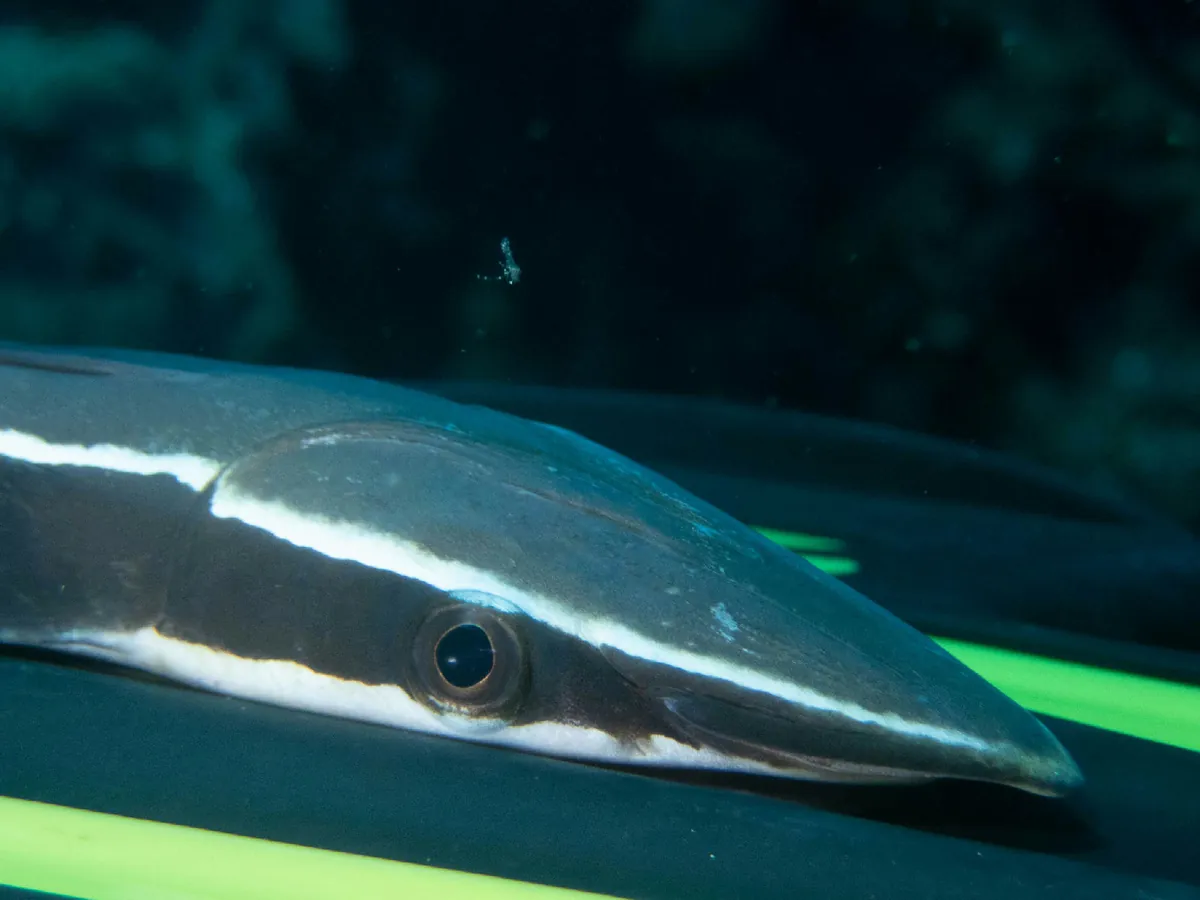
Other remoras have a similar sucking disc, but the live sharksucker's strongly protruding lower jaw and the dark, white-edged stripe running the full length of its body set it apart.
This is a long, slender fish, growing up to 110 cm, with a lower jaw that juts out noticeably past the upper one. Its body is dark grey to brown with a darker belly, and a dark stripe edged in white runs the length of its side from eye to tail. The tail fin is black with white corners. On top of its head, where most fish have a dorsal fin, it instead has an oval sucking disc made of ridged plates.
Sharksuckers live in tropical and warm temperate seas worldwide, from close inshore to open water down to about 85 m, though they are most often seen shallower. They spend much of their time attached to a larger animal, or free-swimming near reefs when they are not.
Young fish clean small parasites off reef fish. Once attached to a host, an adult feeds on the host's parasites, scraps from its meals, and small food filtered from the water. Free-swimming individuals near shore eat crustaceans, squid and small fish.
Harmless. It has no teeth or spines worth worrying about; an attaching one feels like suction, not a bite.
Some fishers tie a line to a live sharksucker's tail, release it, and let it attach to a bigger fish, then haul in both the remora and its catch.
Describe what you saw and we name it, then keep every species you find in your Oceandex.