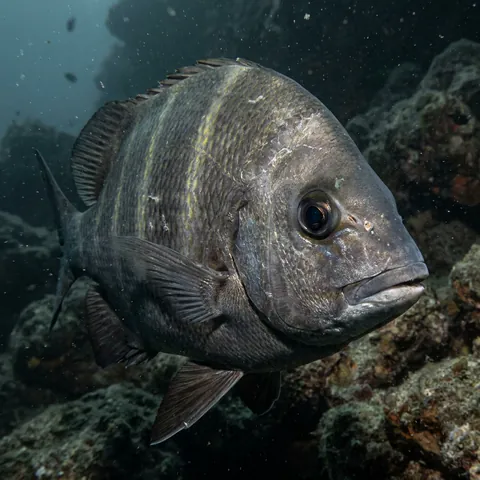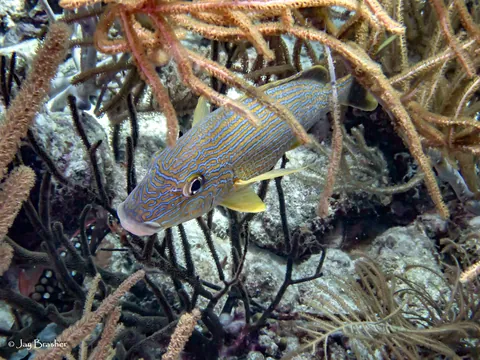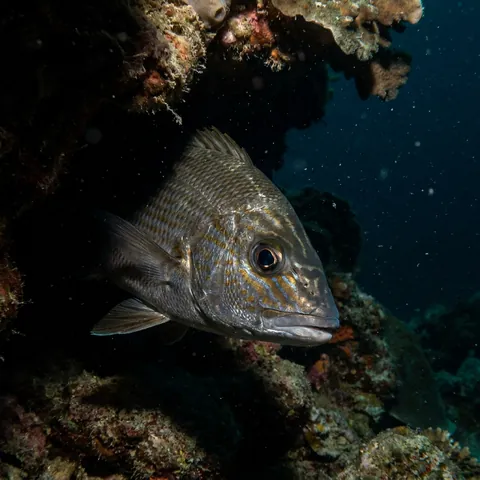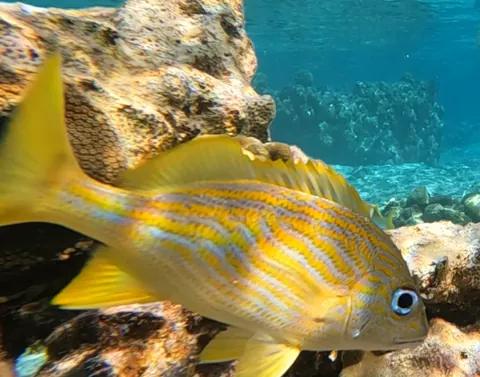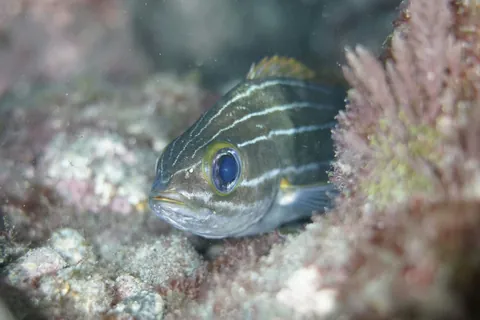
African Striped Grunt
Parapristipoma octolineatum
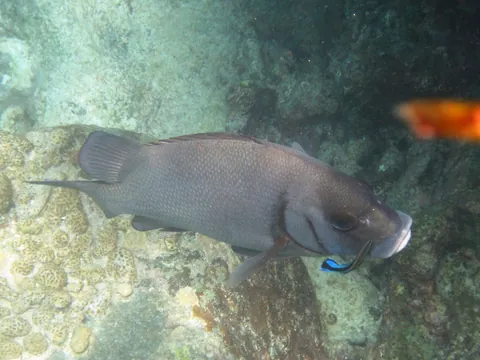
Plectorhinchus chaetodonoides
The harlequin sweetlips is a large, heavy-bodied reef fish in the grunt family. It is named for its lips, which are fleshy and grow noticeably thick as the fish gets older. It reaches 72 cm and about 7 kg, though 60 cm is more usual. It hunts at night, taking crustaceans, shellfish and small fish off the bottom, and spends the day resting in the shade.
Also known as: many-spotted sweetlips, spotted sweetlips, spotted blubber-lips
Juveniles and adults look so different in colour that they are easy to mistake for two separate species. The safest check at any age is the spot-to-eye comparison: on a grey adult, the dark spots are each wider than the coloured ring of the eye, a rule that holds regardless of lighting.
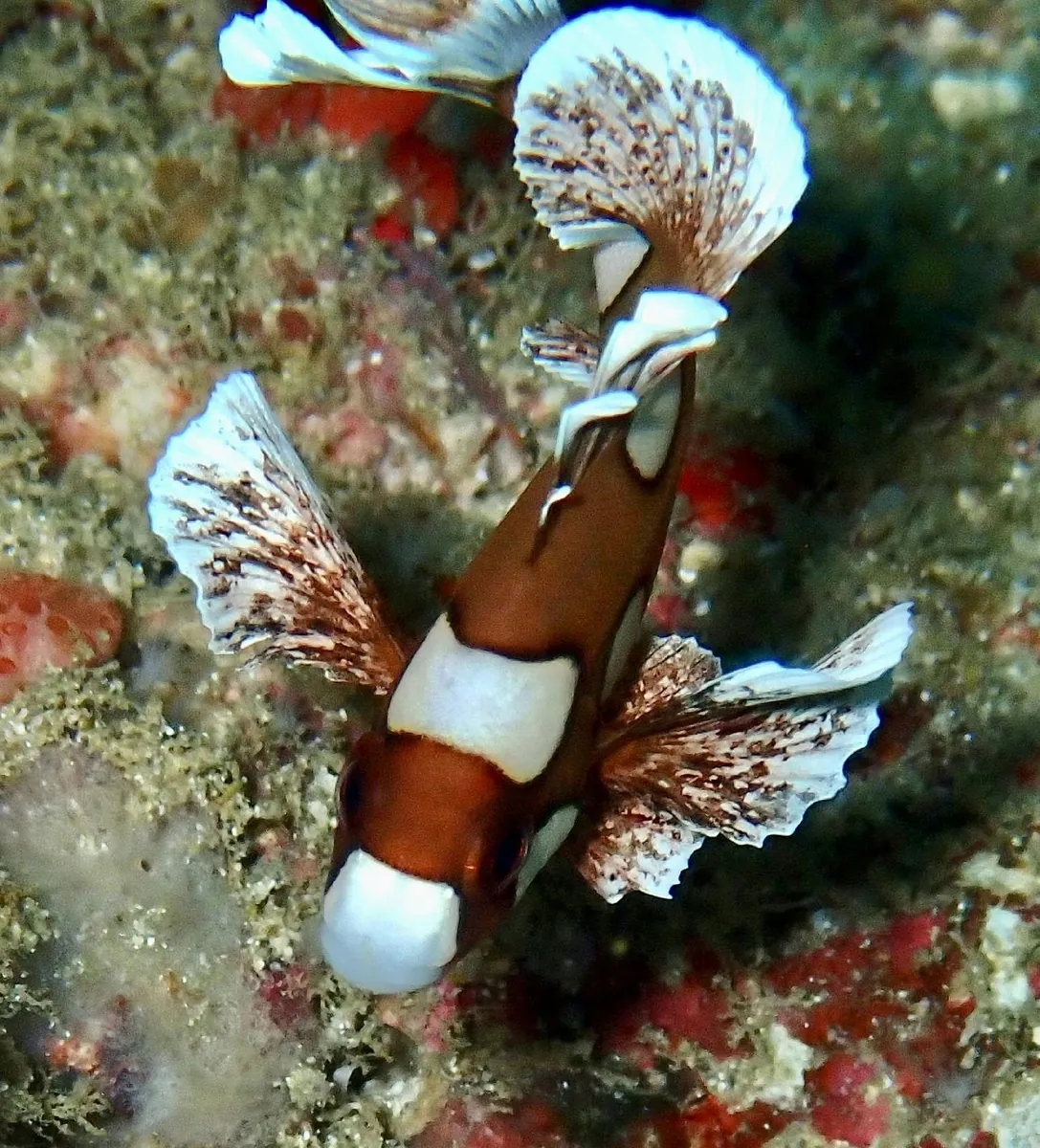
The colour changes completely with age. A juvenile is brown with large, well-separated creamy white blotches, and its tail is deeply forked with wide, rounded lobes that are mostly white with one big brown spot on each. As the fish grows, brown speckling creeps into the white patches, and the pattern slowly reverses: an adult is greyish with large dark brown spots scattered over it. Each of those adult spots is wider than the coloured ring of the eye. The tail of an adult is much less deeply forked than a juvenile's, and the body is deep and solid with thick, swollen lips.
It lives in the eastern Indian Ocean and the western Pacific, from the Maldives and Mauritius east to Tonga, and from southern Japan south to the Great Barrier Reef. It wants coral-rich ground in clear water, either in a lagoon or on a seaward reef, from 1 m down to 30 m. Adults are solitary and spend the day close to or tucked under a ledge or in a cave, so you often find one hanging in the shade rather than out in the open. Young fish shelter among the corals themselves.
The juveniles seem to pretend to be something poisonous. They swim nose-down, waving their fins in a loose, floppy way, and the effect looks like a toxic flatworm drifting over the reef. Predators that avoid flatworms are thought to leave the young fish alone.
Describe what you saw and we name it, then keep every species you find in your Oceandex.