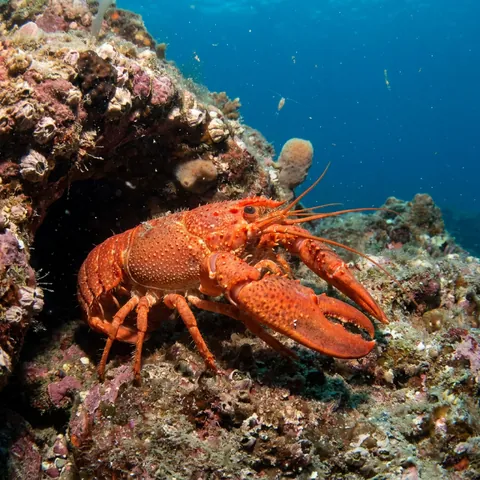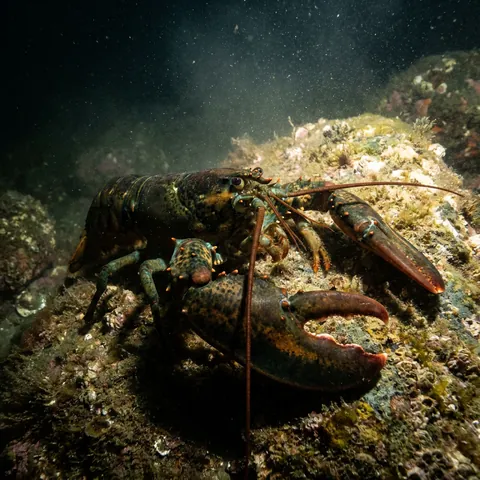
American Lobster
Homarus americanus
Homarus gammarus
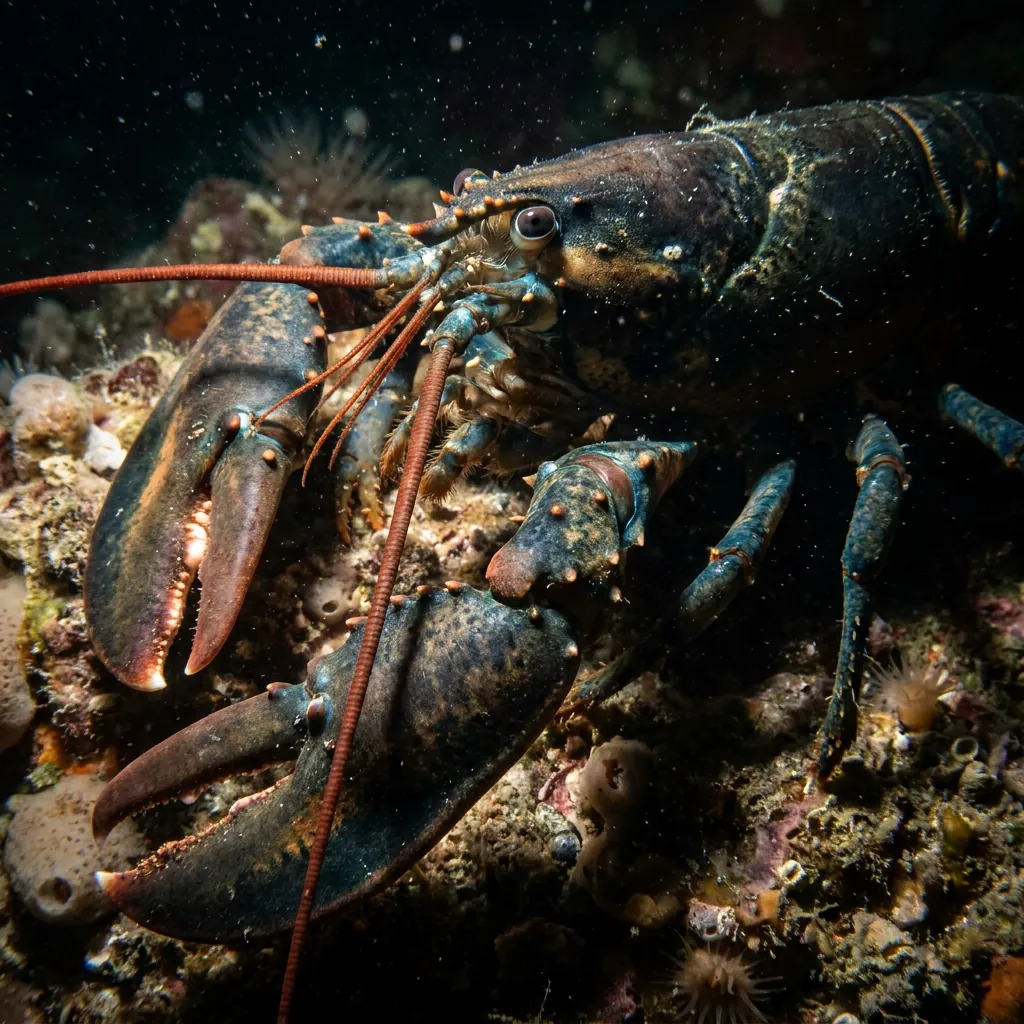
The European lobster is a heavily armoured seabed hunter known for its lopsided pair of claws, one built for crushing and one for cutting. It can grow to 65 cm and 6 kg, though most lobsters seen are closer to 40 cm.
It is easily mistaken for its close relative, the American lobster, but the European lobster's blue shell with a yellow underside separates the two.
Its shell is blue on top, often with spots that run together, and yellow underneath; the familiar red colour only appears after it is cooked. The first pair of legs carries two very different claws, a larger rounded one for crushing prey and a slimmer, sharp-edged one for cutting and holding it, usually with the crusher on the left.
It lives on the seabed, sheltering in holes and crevices, at depths down to 150 m, though it is usually found no deeper than about 50 m. Its range covers the northeastern Atlantic from Norway to Morocco, and most of the Mediterranean Sea.
It is nocturnal and territorial, staying in its burrow or crevice by day. It scavenges and hunts a wide range of prey, including crustaceans, molluscs, and worms, and will also eat carrion and plant matter. Females carry their eggs attached under the tail for many months before they hatch at night.
Once lobster eggs hatch, the drifting larvae face such long odds that only a tiny fraction ever survive long enough to settle on the seabed and start life as juveniles.
Describe what you saw and we name it, then keep every species you find in your Oceandex.