Day Sarpon
Alepisaurus ferox
About
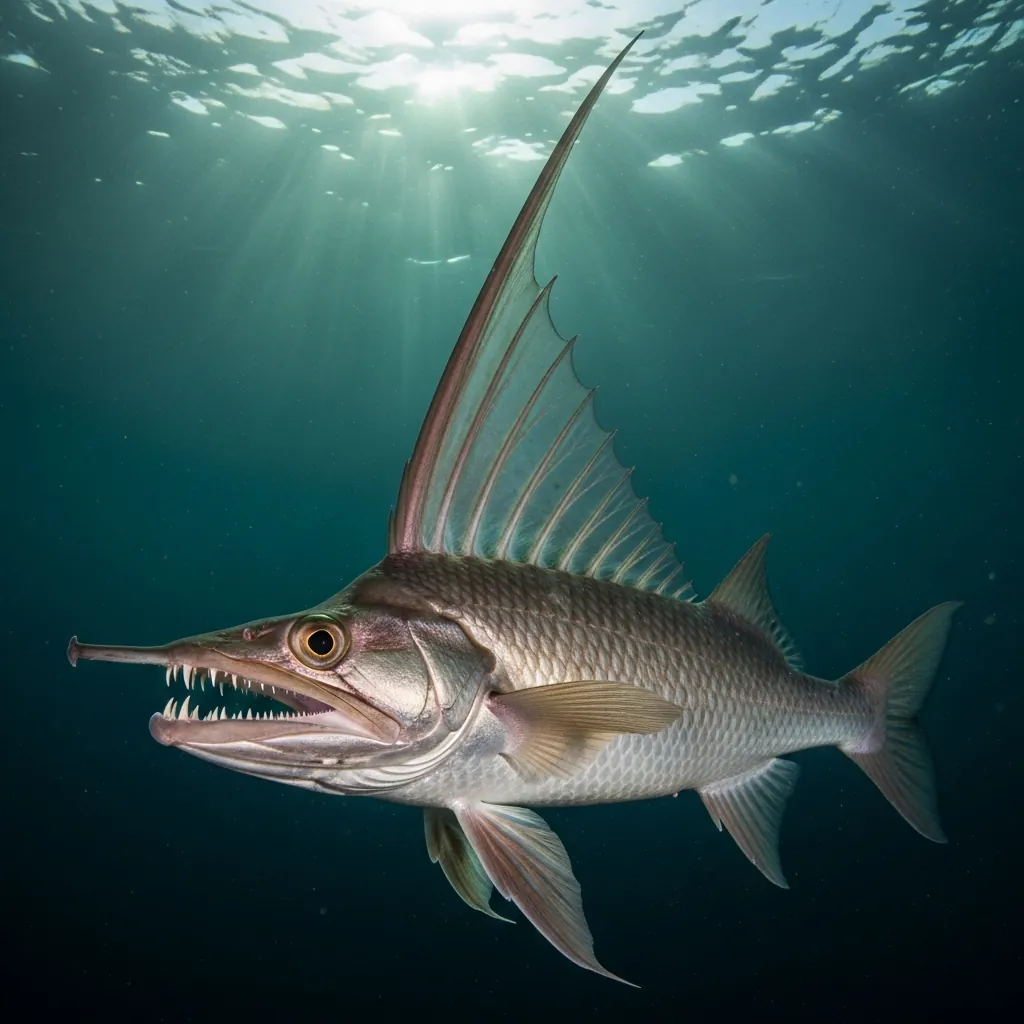
Long, pale and shining, with a sail on its back and fangs in its mouth, the lancetfish is an open-ocean hunter that most divers will never meet in the water. It reaches about 215 cm, and it ranges from near the surface down to 1,830 m. The teeth are not for chewing. They are for tearing prey apart and for cutting the muscles of anything still fighting.
Also known as: handsaw fish, lancetfish, long snouted lancetfish, long snouted lancetfish, lancetfish, longnose lancetfish, longsnouted lancetfish, longsnout lancetfish, longnose lancetfish, pacific lancetfish, handsaw-fish, lancet fish, handsaw fish, wolffish, lancet fish
- Length
- 1.5 m · max 2.1 m
- Weight
- max 9 kg
- Depth
- up to 1830 m
How to tell it apart
You are far more likely to see this fish hooked, stranded or on a boat deck than swimming past you. Set against other long, pale, open-water fish, the settling mark is that tall sail down the back with its first rays drawn out above the rest. Then open the mouth: the pair of upright fangs in the roof confirms it.
Appearance
A slim, drawn-out fish, pale and shining, darker along the back. The dorsal fin is very high and runs along the back like a sail, with about three of the front rays pulled out well above the rest. Behind it sits a small second fin with no rays, called an adipose fin. The mouth is large and carries two fangs standing up in the roof. Every fin is dark brown or black, and a dark ridge runs along each side near the tail.
Habitat
This is a fish of the open ocean rather than the reef. It lives in the Pacific from the Aleutians to Chile, in the western and eastern Atlantic, in the Indian Ocean and the China Sea, and it has been recorded as far north as Russia. It mostly keeps to warm and mild seas, but feeding adults push up into cold northern water. Each day it rides up and down the water column, from the sunlit layer down into the dark, and it sometimes comes close inshore.
Diet
The lancetfish eats almost anything it meets, and its prey has been traced to 98 different families. What it takes depends on where it lives. It hunts down to 1,830 m, and stomach studies show prey from both the sunlit layer and the lightless one below. Its gut is a large blind sac that holds food and digests it slowly. Man-made rubbish turns up inside too, plastic included.
Breeding
This species is a synchronous hermaphrodite. That means each fish carries working male and female parts at the same time, rather than switching from one to the other as it ages. It lays eggs, and the young drift as part of the plankton before settling into adult life.
Did you know?
The lancetfish is also called the cannibal fish, because it eats its own kind. How often it does so depends on how easy other prey is to find, and the bigger a lancetfish is, the sooner it will turn on another.
Log it in Into the Blue
Describe what you saw and we name it, then keep every species you find in your Oceandex.