Chocolate Talking Catfish
Acanthodoras cataphractus
About
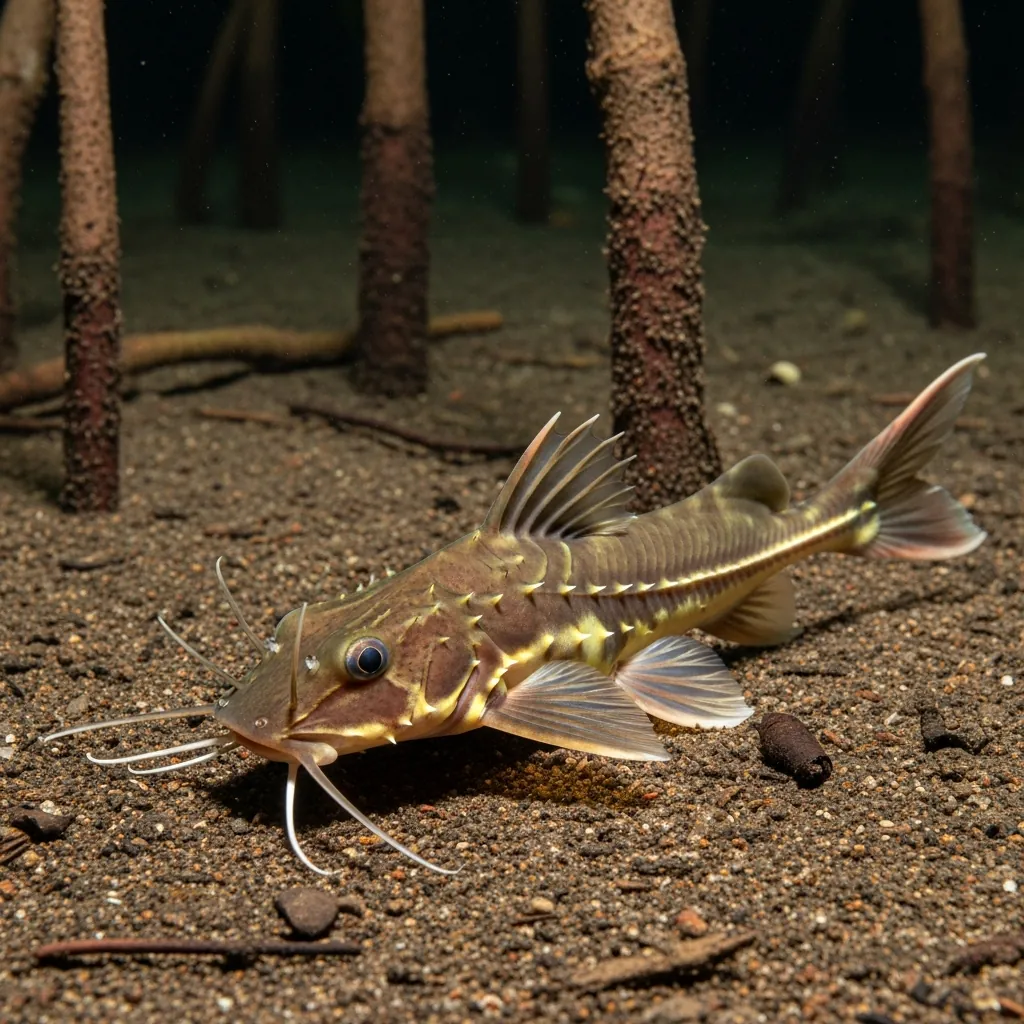
The chocolate talking catfish is a small, blunt, night-working fish of still tropical water. It grows to about 11.5 cm and likes it warm, between 22 and 26 C. By day you will not see it at all. It lies tucked into sunken roots and stumps, and only comes out as the light goes.
Also known as: chocolate raphael, spiny catfish, spiny catfish, talking catfish, talking catfish, spiny catfish, spiny catfish
- Length
- 11.5 cm
- Temperature
- 22–26 °C
How to tell it apart
Small brown catfish in a root tangle all look much the same in torchlight, and colour will not help you. Look along the side of the body instead. This fish carries a single line of bony plates running down each flank, so the side is armoured rather than smooth. A plain-sided catfish of the same size and shape is something else.
Appearance
It is squat and a little tadpole-shaped, with no scales. The head is large, flat on top and heavily boned. The mouth sits right at the front of the snout and carries three pairs of barbels, the long feelers a catfish uses to taste and feel its way. The barbels also give away the sex: on a male they are streaked brown and yellowish white, while on a female they are plain yellowish white.
Habitat
This is a fish of calm water, and it is common where it occurs. Look in swamps and among mangroves, and in the quiet edges of rivers across northern South America, from Bolivia and Peru through Brazil to the Guianas. It needs cover, so it favours ground broken up by roots and stones. It feeds by digging into the bottom, taking mostly rotting matter, plus worms and insect larvae, which makes fine, soft sediment part of what it needs.
Did you know?
If it wants to disappear, it does not swim off. It digs into the bottom at lightning speed and settles there with only its eyes showing above the sediment.
Log it in Into the Blue
Describe what you saw and we name it, then keep every species you find in your Oceandex.