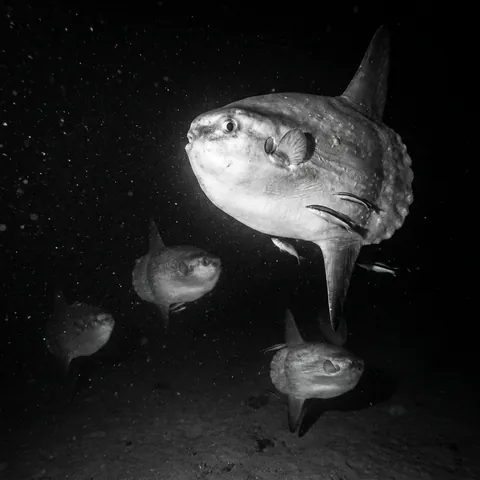
Ocean Sunfish
Mola mola
Mola alexandrini
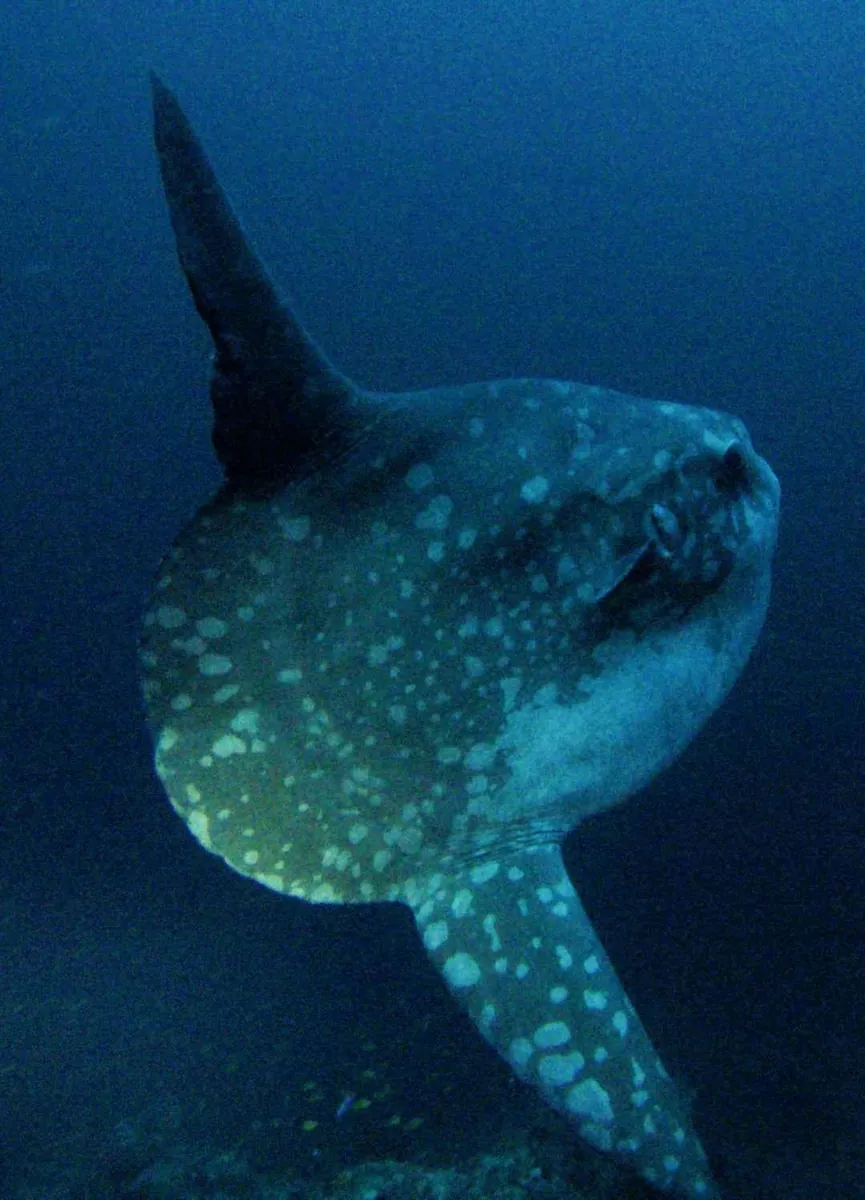
The bump-head mola is one of the ocean's strangest fish. It has no tail fin, and its huge flat body looks like a swimming head cut off in the middle. Despite that odd shape, it is one of the largest bony fish in the sea.
Also known as: bump-head sunfish, ramsay's sunfish, southern sunfish, southern ocean sunfish, short ocean sunfish, ramsay's ocean sunfish, short sunfish
Divers sometimes confuse this species with the ocean sunfish, Mola mola. Look at the head and chin: this species develops raised bumps there as it ages, which the ocean sunfish lacks.
Its body is flat, round, and squashed from side to side, with no proper tail. Large fins on the top and bottom flap back and forth to push it through the water. The skin is rough and leathery, in brown and grey with pale blotches, covering a thick, jelly-like layer underneath. Its mouth is small, and the teeth are fused into a beak, like a parrotfish. There is no dorsal spine and no pelvic fins at all.
This mola lives in the open ocean, far from any reef, across most of the world's tropical and temperate seas. It avoids the coldest polar waters but tolerates a wide range of temperatures. It often gathers where ocean currents meet, and moves up and down through the water column, staying below the thermocline, the layer where temperature drops sharply, during the day and rising nearer the surface at night.
It swims by beating its top and bottom fins together rather than side to side. Divers usually see it alone or in pairs, though small groups do form. It dives deep to feed in cold water, then may return to warmer shallows to recover. Tiger sharks and orcas are known predators, though attacks are rarely seen.
Jellyfish make up most of its diet, even though they offer little nutrition, simply because they are easy to find in large numbers. It also eats brittle stars, small fish, plankton, algae, salps, and molluscs.
As young fish grow, bumps form on the head and chin, and ridges develop along the sides, features that build up gradually with age. Adults spawn in open water within the temperate Atlantic and Pacific Oceans, and in the Mediterranean Sea.
This species has not yet been formally assessed. It is caught as bycatch in fisheries around the world, and longline fisheries off eastern Australia rank it as a high-risk bycatch species. Indonesia has begun work on a protection plan for sunfish.
A bump-head mola holds the record for the heaviest bony fish ever recorded, beating every other fish species with a bony skeleton.
Describe what you saw and we name it, then keep every species you find in your Oceandex.