Atipa
Hoplosternum littorale
Ameiurus nebulosus
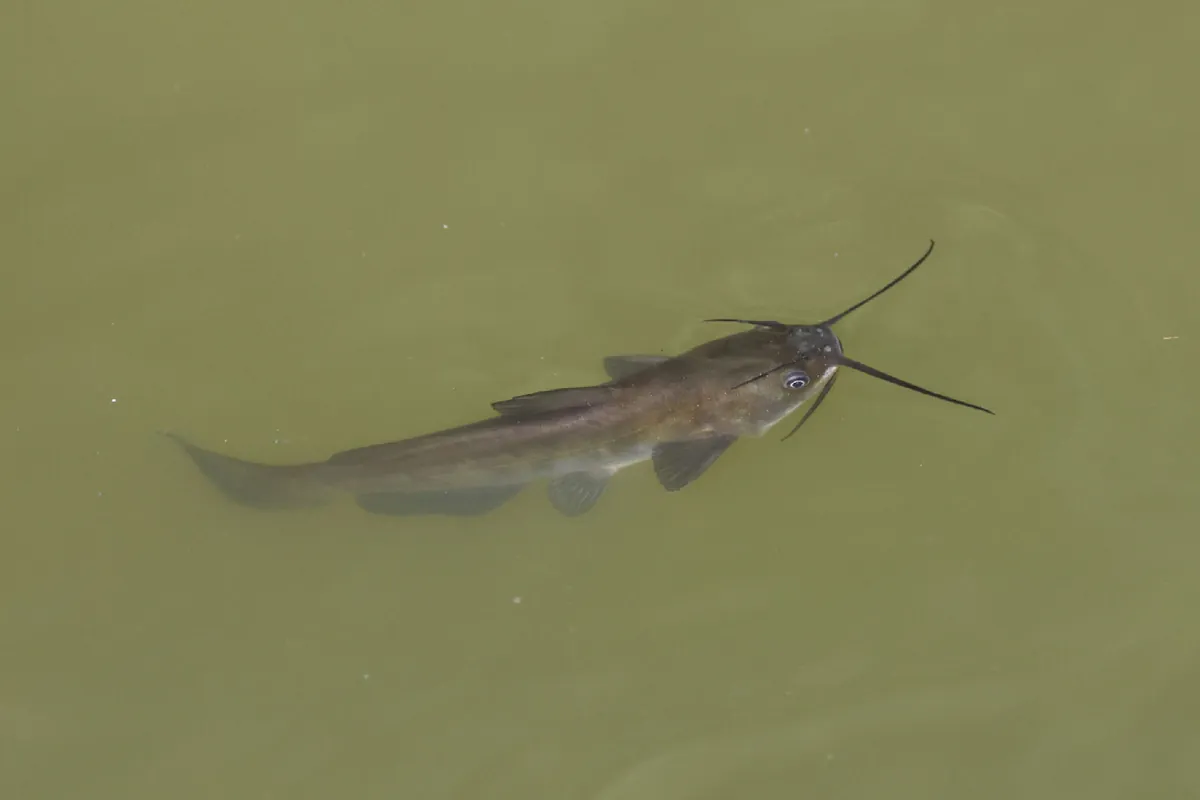
The brown bullhead is a hardy, scaleless catfish that thrives even in murky, low-oxygen water where few other fish survive. It can grow to 55 cm, though most seen are closer to 25 cm.
Also known as: Ameiurus nebulosus; horned pout; mudcat
It closely resembles the black and yellow bullhead. Check the chin barbels: on the brown bullhead they run black to yellowish-brown, a shade the similar species usually lack.
This catfish has a smooth, scaleless body, dark brown-green on top fading to cream on the belly, with brown-black speckles scattered over its skin. It has a single spine on the dorsal fin, a small fleshy adipose fin behind it, and eight barbels, or whisker-like feelers, around its mouth. Its tail is only lightly notched rather than deeply forked.
It lives in lakes, ponds, and slow streams across eastern North America, and has been introduced widely elsewhere. It favours muddy, low-oxygen water and depths down to about 5 metres, often hiding by day and coming out to feed at night.
Brown bullheads are social and stay in one place rather than migrating, often gathering in loose schools. Both parents guard the nest and the newly hatched young, keeping the school of juveniles together for up to a month.
It is an omnivorous bottom feeder, eating algae, worms, leeches, insects, small crustaceans, and other small fish, along with fish eggs. Since its eyesight is poor, it relies on its sensitive barbels to find food, mostly at night.
Harmless, but the pectoral and dorsal spines can give a painful jab if you pick one up.
The brown bullhead has no special protected status and is often the most abundant fish in the lakes and streams it lives in. Its unusual tolerance for polluted, low-oxygen water helps it survive where many other species cannot.
In 2026, scientists identified a form of cancer that spreads between individual brown bullheads like a contagious disease, found in fish from Lake Memphremagog.
Describe what you saw and we name it, then keep every species you find in your Oceandex.