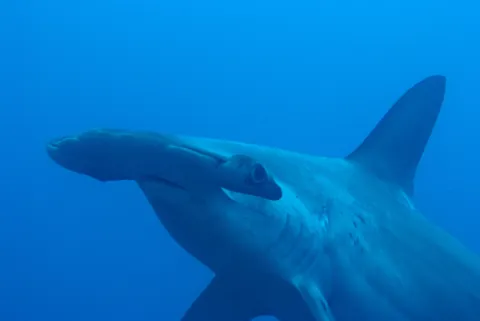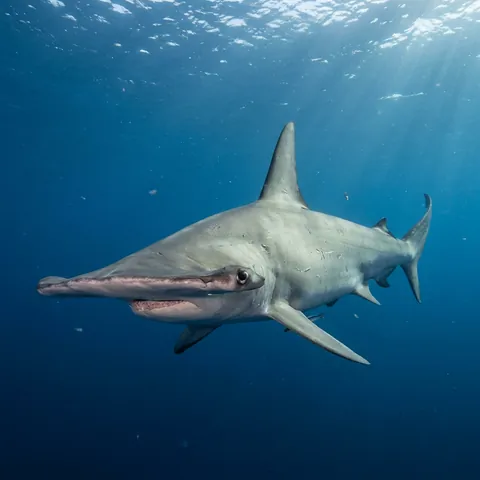
Great hammerhead
Sphyrna mokarran
Sphyrna tiburo
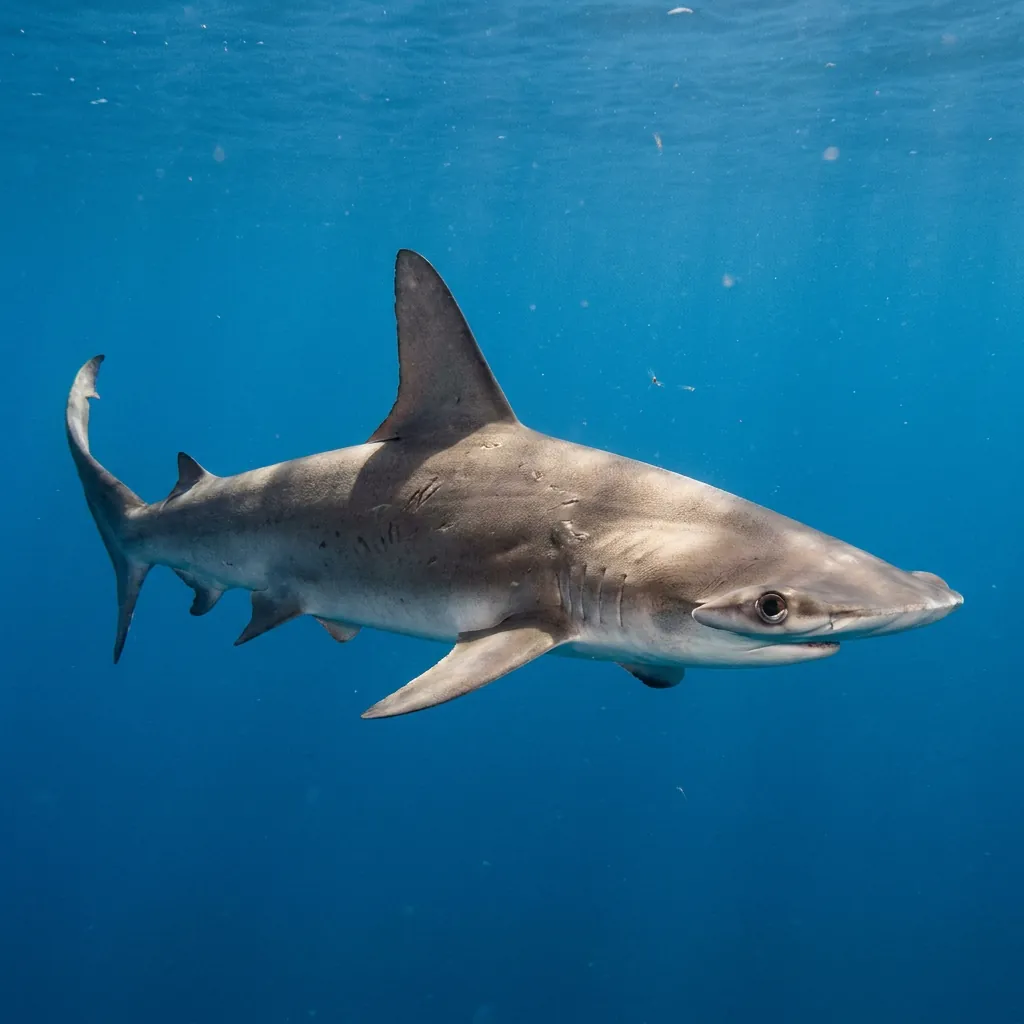
The bonnethead is the smallest of the hammerhead sharks, with a smooth, shovel-shaped head instead of the wide hammer of its relatives. It usually grows to about 80 cm, with the largest reaching 150 cm.
Also known as: shovelhead, bonnethead shark
Unlike other hammerheads, whose heads spread into a wide hammer, the bonnethead's head is smooth and spade-shaped, without the flattened side lobes.
The body is grey-brown above and paler below, with a broad, smooth, spade-like head. Females have a rounded front edge to the head, while mature males develop a distinct bulge along it, a difference not seen in any other shark.
It lives in warm coastal waters on both sides of the Americas, favouring shallow estuaries and bays over seagrass, mud, and sand, as well as coral reefs. It is usually found from about 10 to 25 m deep, down to a maximum of 80 m.
Bonnetheads swim constantly in small groups of five to fifteen, sometimes gathering in far larger schools. Because they are strongly negatively buoyant, they must keep swimming or they sink, and they follow water temperature changes to stay comfortable.
It sweeps its head side to side across the seabed like a metal detector, sensing crabs and other prey hidden in the sediment before biting down. Blue crabs are its main food, along with shrimp, molluscs, and small fish, but it also eats large amounts of seagrass, making it one of the few omnivorous sharks.
The bonnethead gives birth to live young after one of the shortest pregnancies known among sharks. Pups are born in late summer and early fall.
The bonnethead is heavily fished across its range and now classed by the IUCN as Largely Depleted. It remains fairly common along the US Atlantic coast, but has declined sharply in the Caribbean and disappeared from much of its former range in South America and the Pacific.
One captive bonnethead gave birth without ever mating; DNA tests confirmed the pup was a genetic match to its mother alone.
Describe what you saw and we name it, then keep every species you find in your Oceandex.