Beaked Whale
beaked_whale
About
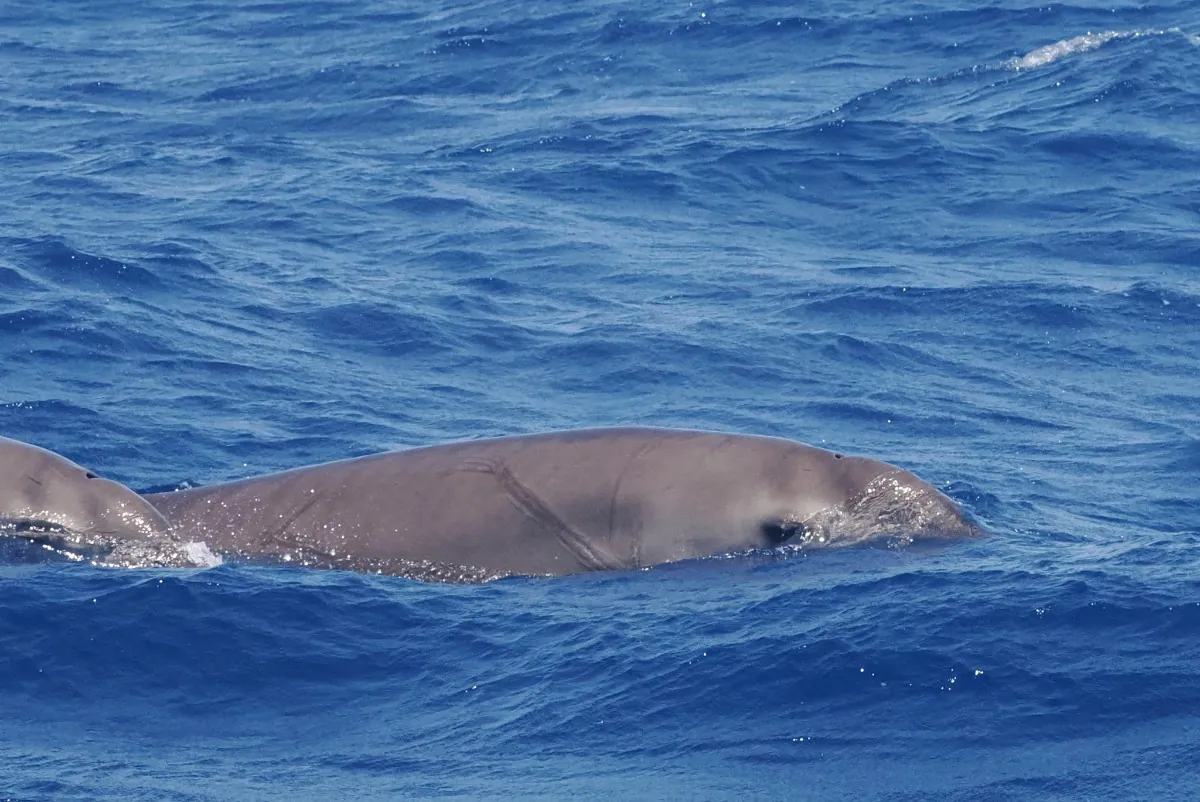
Beaked whales are deep-diving whales with a dolphin-like beak. They are shy and rarely seen, spending most of their time in deep water far from shore.
How to tell it apart
The mark that settles it against other whales and dolphins is the tail fin: beaked whales have no notch down the middle, unlike almost every other whale or dolphin. Individual species are very hard to tell apart in the water; divers mostly rely on overall size, forehead shape, and beak length.
Appearance
Beaked whales grow from 4 to 13 metres long. They have a beak like a dolphin's, a pair of grooves under the throat, and a tail fin with no notch in the middle. Most have only one or two teeth, which often stay hidden inside the gums, especially in females. Adult males often have a large, bulging forehead.
Habitat
Beaked whales live in deep ocean water, usually far from the coast. They spend much of their time diving deeper than 500 metres to hunt.
Behaviour
Beaked whales dive very deep and can stay down for a long time, then come up and rest at the surface for over an hour before diving again. They often surface together, but this is not always the case, and it is hard to see or count them because they show themselves so little.
Diet
Beaked whales hunt mainly deep-water squid, along with some fish and crustaceans near the sea floor. They do not bite their prey; instead they suck it into their mouth by suddenly opening their throat and pulling back the tongue.
Breeding
Very little is known about how beaked whales breed. Pregnancy length varies by species, from about 12 to 17 months.
Is it dangerous?
harmless to humans
Did you know?
Most beaked whales have almost no visible teeth. Instead of biting their food, they suck squid and fish into their mouth like a vacuum.
Log it in Into the Blue
Describe what you saw and we name it, then keep every species you find in your Oceandex.