Atlantic Sturgeon
Acipenser sturio
About
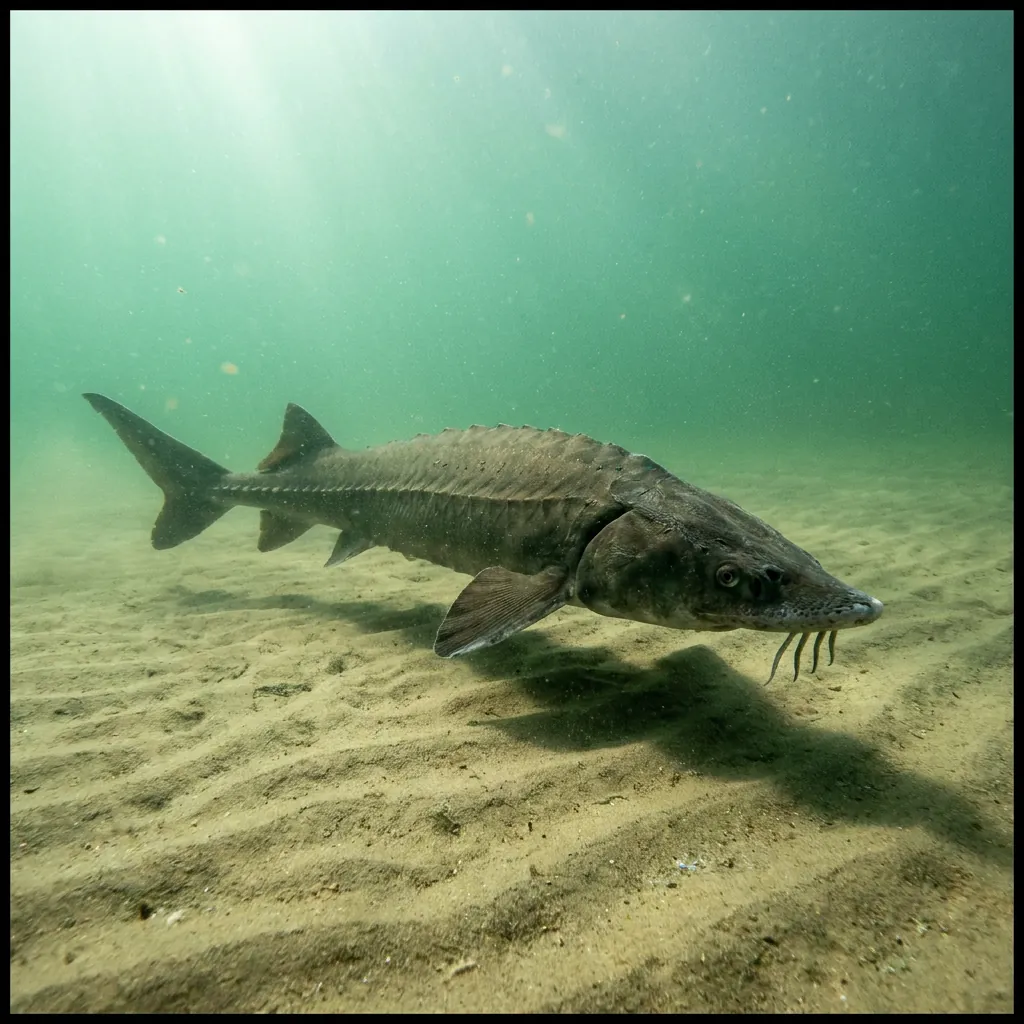
The Atlantic sturgeon is an ancient-looking fish covered in bony plates, cruising slowly over the seabed as it feels for food with its barbels. It can reach 600 cm long, though a more common length today is 125 cm.
Also known as: acipenser sturio, baltic sturgeon, common sturgeon, european sturgeon, sea sturgeon, sturgeon
- Length
- 1.3 m · max 6 m
- Weight
- max 400 kg
- Depth
- 5–60 m
- Temperature
- 10–18 °C
How to tell it apart
Other sturgeon species share the same armoured look, but the Atlantic sturgeon's lower lip is split, with a clear gap at the centre rather than forming one unbroken line.
Appearance
This fish has a long, wedge-shaped head ending in a narrow, pointed snout, with sensitive barbels hanging in front of its mouth. Its body carries five rows of large bony plates instead of scales, and its dorsal fin sits far back near the tail. It is greenish-brown to black above with golden tints, silvery on the flanks, and white below.
Habitat
Atlantic sturgeon live along coasts and estuaries over sand or rocky bottoms, from about 5 to 60 m deep. They spend most of their life at sea but swim into large rivers to spawn.
Is it dangerous?
harmless
Conservation
This species is Critically Endangered. Fewer than 800 wild adults are thought to remain, and the entire wild population alive today comes from just one river system in France.
Did you know?
Every wild Atlantic sturgeon alive today descends from a single mating pair that spawned in the Garonne River in France in 1994.
Log it in Into the Blue
Describe what you saw and we name it, then keep every species you find in your Oceandex.